
“Spero”—I Hope
A personal "creed" that I hope is true

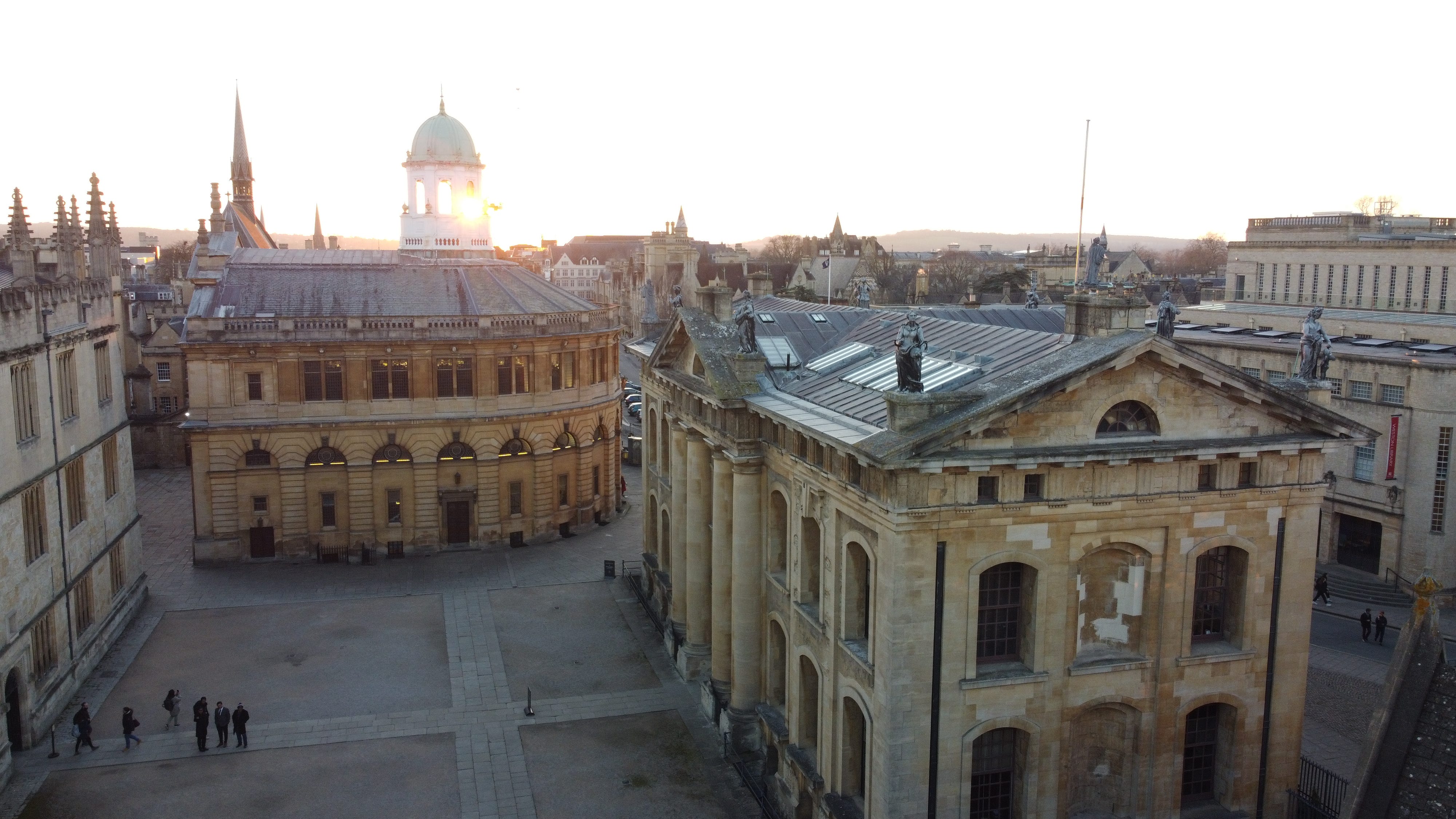
(Photo credit: me—of Oxford University, March 2022.)
(A seven-minute read.)
Two quick stories and then a list.
First story: five years ago, during my first trip to Oxford for my doctoral studies, I ended up getting together with a couple younger graduate students at a coffee shop. I had met them at Oxford’s Graduate Christian Forum a couple nights before and they seemed interested in hearing more about my journey and getting a little inspiration from an “older” pastoral figure.
One of them was from China and the other from Germany, and we all had unique faith-journeys—and all of us, in our own distinct ways, were trying to figure out how to navigate spirituality in a high-pressure academic setting.
I don’t remember how it exactly came up, but at one point, one of them, looking for a little inspiration from a more seasoned Christian, asked me why I was so confident in my faith. And I remember telling them something along the lines of, “You know, I believe in the message of Christianity as much because I want it to be true as because I know it’s true.”
I’ll never forget: they just looked at me with a bit of befuddlement and disappointment. Apparently, my answer was flimsier than they were hoping for.
But that’s what I could offer them.
That leads to—and reminds me of—story two. I just came across it again in my prayer journal the other day, but about 18 months before that encounter at Oxford, I had written a list of about fifteen “doctrinal” points that I felt like I could say I “believed.”
Such an endeavor reflected—and continues to reflect—my ongoing journey of sorting through my faith. Some would call it “deconstruction,” but that term sometimes seems too strong or trendy—though I’d unequivocally say that if you’re not continuously “deconstructing” then you’re not growing.
As finite creatures who are trying to understand an infinite God to greater degrees, we had better be continuously coming into new insights about the divine, or discarding older understandings of God that were immature, or coming into fuller perspectives about ideas that were (and will always be) incomplete.
All this is building up to a point: I’m going to share a list with you today. It’s something I’ve been meaning to do for a while. Originally, I had thought about sharing a list of “beliefs” about which I continue to have a high degree of confidence. I was going to point out that it was a list of “beliefs” and not a list of “indubitable certainties,” noting that I’m saying “I believe” rather than “I know” (my Latin isn’t exactly at a graduate level, but it would be the difference between credo—from where we get the word “creed”—and scio—from where we get the word “science”).
Instead, however, I’m going to frame it as “I hope,” or “I wish” (spero in Latin, rather than credo). These are metaphysical ideas that I hope are true. They are chapters in a transcendent story that I’d love to organize my life around—convictions and desires that I’d be hard-pressed to give up because they speak to my heart, give meaning and structure to my life, and provide me with hope.
They are, in many ways, desires that I’m willing to be “wrong” about, because life would lose a lot of meaning if I surrendered them—which doesn’t mean they are necessarily “true” in some Enlightenment-defined, scientific way, of course (though I also have a fair degree of confidence that they do correspond to the reality of the universe—though that’s a discussion for another day).
So without further ado, I want to share my list—which is always a work in progress—of the bedrock metaphysical “beliefs” that I hope are true and around which I seek to organize my life. There are—I guess—21 of them right now.
I hope that there is one God who governs the universe with perfect, self-giving, and steadfast love. He is personal and plural, one God consisting of three persons, comprised of a small community that created the universe—not from necessity but from love.
I hope that Jesus is the ultimate revelation of who this God is, and that the cross is the pinnacle of his divine self-disclosure.
I hope that the Spirit is God’s ongoing connection to humanity and creation, drawing all things toward truth, beauty, healing, and love.
I hope that I’m a part of a glorious story, where God and his love are the center, and that the story is building to a grand crescendo where we will live forever with God and one another in perfect fellowship, harmony, and love.
I hope that God, reflecting his character of love, created this universe and world through his sovereign power, rather than through death and destruction.
I hope that God has created the universe in such a way that it operates by laws—physical, moral, spiritual, social—that provide safety, security, consistency, and harmony if maintained and honored.
I hope that God has created the universe to be full of beauty, diversity, uniqueness, and splendor.
I hope that the universe operates from a place of rest rather than restlessness, and that God has embedded into its rhythms a time for regular—weekly, even—refreshment, rejuvenation, recreation, and connection.
I hope that the brokenness and sin which sadly characterize our world were a departure from the story God originally intended for us—the result of the free choices of his creatures, rather than a divine plan which he unilaterally ordained.
I hope that the Bible is, in ways I don’t fully comprehend or understand, the primary—though not exclusive—way that God revealed and continues to reveal his story of love to us.
I hope that God’s love for us is not determined by our ability to hustle or perform—though I also hope that his love for us is dynamic, reflecting the unique qualities and actions that we humbly offer him and the world.
I hope that our “salvation,” whatever that term exactly means, comes to us as a gift rather than a reward—the result not of perfect human performance but of divine grace.
I hope that Jesus really rose from the dead physically, and that because of this miraculous act, all that go to sleep committed to his love will also raise from the grave one day at his return.
I hope that God will one day fully set this world—and universe—back to a place of harmony and peace, characterized by unending justice, mercy, and compassion.
I hope that the ultimate fixing of the world is not entirely dependent on humanity’s abilities or wisdom—which are limited and imperfect, at best—but on God’s merciful rescuing.
I hope that there is a people (or “people,” without the article) who, in humble and unassuming ways, continuously catch on to God’s story to greater degrees, and who try to align themselves more fully with his character of love, seeking to be agents of justice, mercy, and reconciliation in the world.
I hope that God will someday mercifully unmask and expose all those who’ve used his name to exploit and abuse others.
I hope that Jesus will return someday soon, to rescue the planet before it self-destructs, and that he ultimately finishes the projects of love that his creatures have begun by the power of his Spirit.
I hope that God’s self-giving love will someday be fully vindicated and affirmed by all the universe’s creatures, eliminating the likelihood that selfishness, violence, exploitation, or abuse will ever rise again in the universe because all have deemed God and his ways to be fully trustworthy and wise.
I hope that God will mercifully bring to an end the existence of all who, no matter how long they are given a chance, will never embrace his love—rather than torturing them forever.
I hope that God will make his home with us on this earth for all eternity—and that the longings I constantly feel in my heart will reach their grand fulfillment by being in his presence forevermore.
Of course, these aren’t the only theological, spiritual, or religious things I hope are true. Nor are they the only things I think are true.
There are other things I hope are true, but the evidence I've seen so far doesn't make them seem likely (e.g., I would hope that everyone, in the end, will choose God and his love, but that’s not looking very likely based on the evidence I’ve witnessed thus far).
So, again, what I hope for and what might actually be are not necessarily the same thing—though I believe what I shared on the above list has a high likelihood of reflecting current or potential reality.
Also, this is one of the problems with “creeds”: they often conceal as much as they reveal—since we could endlessly parse what specific terms mean or don’t mean.
Thus, much of what I wrote in the list is carrying a lot of freight, pointing to larger meanings that are evident to me—but, taken at face value by others, may not necessarily be as obvious (e.g., with #8, the keen reader would probably understand that I’m talking about a weekly Sabbath [and as a Seventh-day Adventist, I mean the Sabbath on Saturday]).
But all that aside, what do you think?
What would you add or take away from such a list?
Shawn is a pastor and church planter in Portland, Maine, whose life, ministry, and writing focus on incarnational and embodied expressions of faith. The author of four books and a columnist for Adventist Review, he is also a DPhil (PhD) candidate at the University of Oxford, focusing on nineteenth-century American Christianity. You can follow him on Instagram, and listen to his podcast Mission Lab.
Shawn, this is a fascinating read. I always appreciate your willingness to think out loud and challenge the rigid structures of faith.
Your Oxford story and subsequent list highlight a really important semantic issue, though. You mentioned the difference between credo (I believe) and spero (I hope/wish). While I respect the humility of not wanting to claim absolute scientific certainty (scio), I think your use of spero accidentally undermines the very convictions you hold dear.
In a Christian context, hope isn't a synonym for a wish; it’s the center of our experience. It is the confident anticipation of the plan of salvation, the resurrection, and Christ’s return.
When you frame your bedrock beliefs as "I hope this is true," it introduces an element of deep ambivalence. It shifts the tone from certainty to uncertainty. If you had said, "My hope is IN the Triune God... My hope is IN the resurrection," I would be right there with you. That is the language of faith navigating academia.
But saying "I hope Jesus really rose physically" sounds like you're harboring deep skepticism. I think that’s why your Chinese and German friends looked at you with befuddlement. They didn't need Enlightenment-style "indubitable certainty," but they did need to see a pastoral figure whose anchor was firmly cast into something.
You have a beautiful list of convictions here. Why choose to frame them with the language of uncertainty when they clearly carry so much weight for you?
I am more than hopeful about all these things.