
I Am Augustine
But why I don't want to be

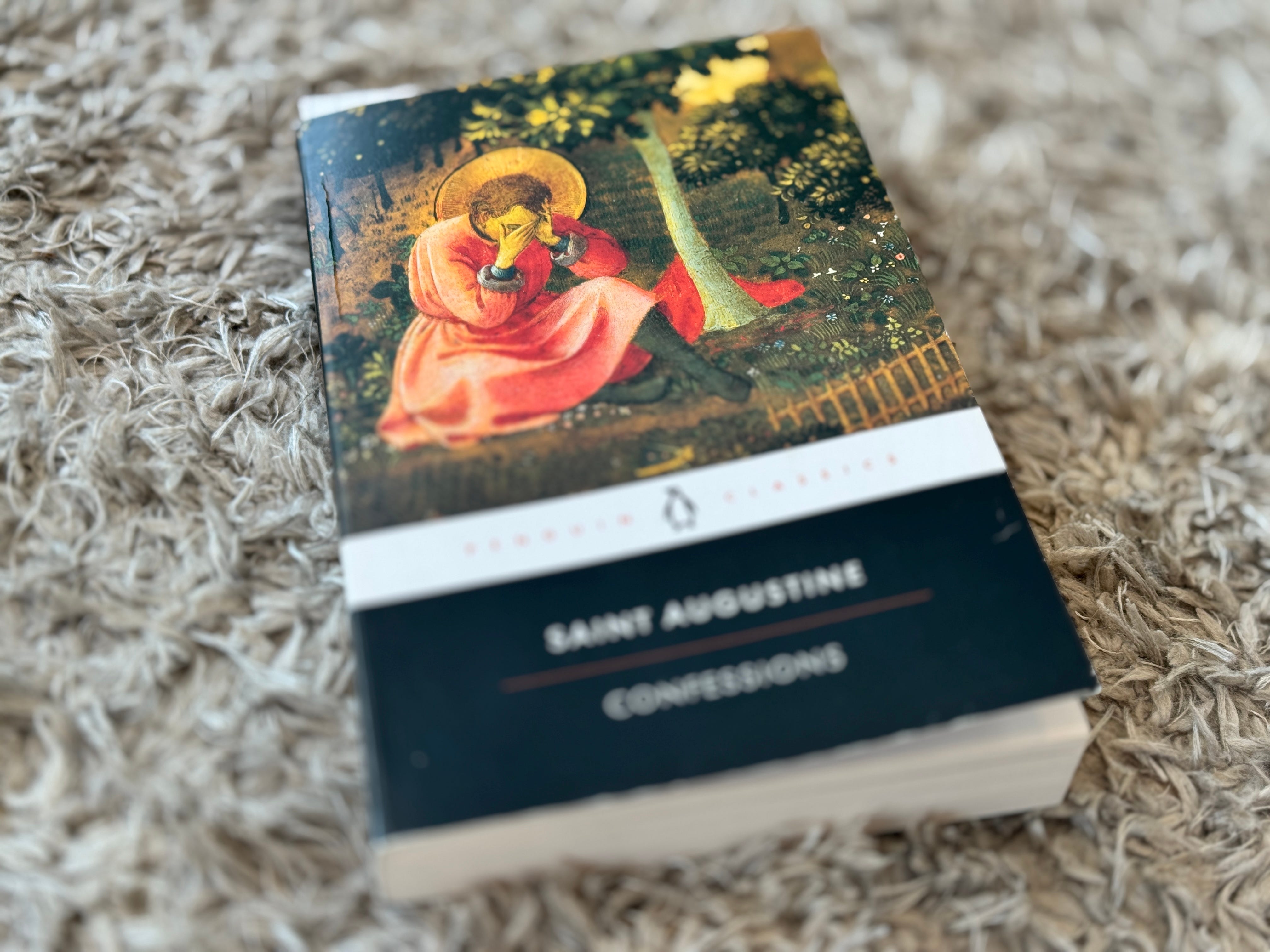
Photo credit: me.
(A four-minute read.)
Lately, I’ve been reading through Augustine’s Confessions, having never read it before—since I come from a Christian tradition with restorationist leanings that essentially maintains that there’s nothing of theological value to explore from about AD 95 (roughly when the Book of Revelation was written) and AD 1517 (when Martin Luther nailed his Ninety-five Theses to the door of the church in Wittenburg, Germany).
I haven’t gotten very far, so I don’t know exactly where Augustine goes (though I have some hunches, of course). But to this point, there’s one thing that acutely jumps out at me: Augustine seems to have been riddled with immense shame. Just about everything he describes from his childhood, before he was fully converted to Christ, is laced from his perspective with utter depravity (which is aptly reflected, by the way, in the cover of this edition of Confessions, shown above, which shows a fifteenth-century painting of Augustine by Fra Angelico).
For example, I just read this line from him, describing when he was studying law at the age of eighteen or nineteen. “It was my ambition to be a good speaker,” he explains, “for the unhallowed and inane purpose of gratifying human vanity.”
Earlier in his Confessions, he spends a great deal of time talking about how he and a group of peers stole a bunch of pears. In explaining why he did it, the only explanation he can come up with is that he delighted in sin. “No sooner had I picked them than I threw them away,” he notes, “and tasted nothing in them but my own sin, which I relished and enjoyed.”
For Augustine, everything he does—even “good” things—is laced with selfishness and sin. So too every other human who comes into the world. Even a one-day-old baby is wholly depraved, reflecting their sinfulness when they cry for milk.
None of my reflections here are groundbreaking, of course. Augustine’s view of humanity, and his claim that we are utterly depraved, has been well-documented for hundreds of years.
Christianity, to a large extent, especially since an Augustinian monk named Martin Luther rocked the western world with his emphasis on the gospel in the sixteenth century, has reflected an Augustinian anthropology. We are born into the world saturated with “original sin” and everything we do—apart from the grace of God—is totally depraved and lined with selfishness and sin.
In sharing these reflections, it’s not my intention to offer a theological assessment here of Augustine’s theology. I’ve sort of done that before—though I’m not sure I came to any conclusive answer.
What I want to instead do is briefly get vulnerable, offering a personal and visceral reaction to what I read from Augustine.
And along those lines, the feeling I get when I’ve been reading has been simply this: I am Augustine.
What I mean by this is, whether good or bad, right or wrong, I’m often overwhelmed with a deep sense of shame when I reflect on my life. I have a perpetual feeling of defectiveness, of inadequacy, of unworthiness. And like Augustine when assessing his own motives for wanting to be a good speaker, I often assume the worst of my own motives—that I always want to do the right things for the wrong reasons.
I don’t know exactly where this stems from. I don’t know if it’s due to nature or nurture or because I have implicitly breathed in the Augustinian air that has come to characterize much of Christianity. Or perhaps it’s a combination of all these.
But for whatever reason—and, again, whether right or wrong—Augustine’s story has so often been my story. Or perhaps it’s always my story, since I can rarely think of a time when this perpetual and ubiquitous feeling of defectiveness has not been subtly bubbling beneath the surface of my psyche.
And equally bubbling beneath the surface is the fear that others are going to find out and discover just how defective and guilty I am.
It may be a simple illustration, but I think of how this is reflected in the way I used to write my little “bio” on my social media handles. For a long while, I’d simply have a quote from Paul’s letter to the Romans, when, in a moment of great vulnerability, he cried out, “O wretched man that I am! Who will deliver me from this body of death?” (Romans 7:24).
That was my identity. I was the “wretched man.” And my theological formation taught me that this was a safe place to be—in fact, the only safe place to be—having a humble and chaste estimation of my own value and worth.
Eventually, about a decade ago, I started reading Brené Brown and Henri Nouwen, and I’d get choked up when I’d read their vulnerable descriptions of their own struggles with shame and unworthiness. And I’d get equally choked up when I’d read about their commitment to recognizing their own belovedness, wondering if it was safe for me to dare believe the same thing about myself.
A decade later, I’m still not sure if I’ve figured it out. There seems to be a tension—at least in my mind.
I’m pretty sure that the extreme Augustinian view about myself isn’t correct; but I also remain convicted that we can’t just give ourselves a “free pass” when it comes to our motives and actions (which, in fairness, I’m not sure Brown or Nouwen are saying either). After all, what does it matter if I’m wholly “beloved” if I continue to be a jerk (or do jerky things)?
(And from a societal perspective, and from a completely different angle, what does it matter if I’m individually loved yet there are people desperate for justice around the world?)
But either way, I have chosen to prioritize and gravitate toward the belovedness idea. And about a decade ago I stopped describing myself—on social media, in real life—as the “wretched man” and instead simply as “Beloved of God.”
Again, it may seem like a simple and silly story. But it’s the story I’m at least trying to live into more and more—all in an attempt to move away from Augustine and into belovedness.
Shawn is a pastor and church planter in Portland, Maine, whose life, ministry, and writing focus on incarnational and embodied expressions of faith. The author of four books and a columnist for Adventist Review, he is also a DPhil (PhD) candidate at the University of Oxford, focusing on nineteenth-century American Christianity. You can follow him on Instagram, and listen to his podcast Mission Lab.
It's as if I were writing this about my own view of self. I've always known I'm unworthy, but also asking God to allow me to see myself as He does, precious.
Thank you! Your vulnerability is so helpful, especially coming from a pastor.